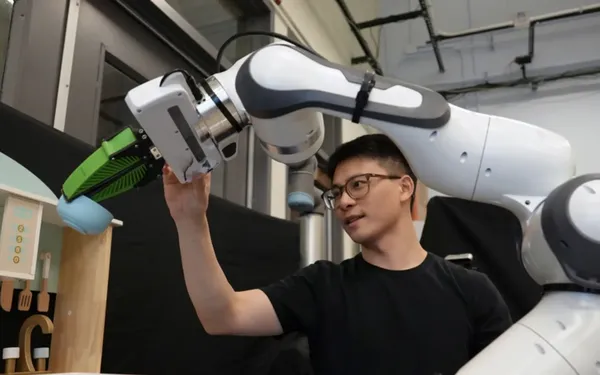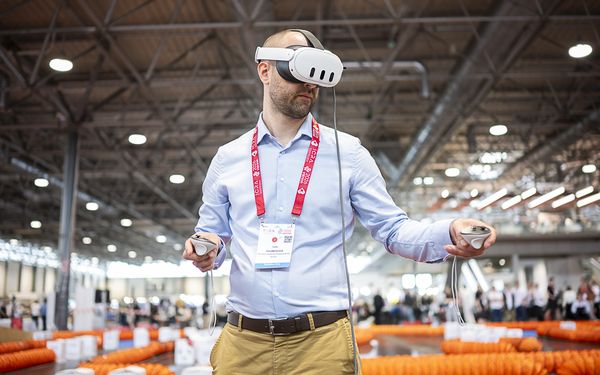
The future of embodied AI depends on several factors, but perhaps none is more important than data [1]. As foundation models continue to scale, access to large, diverse, and high-quality datasets has become the single biggest competitive advantage in robotics [2]. However, collecting that data remains the field’s greatest operational bottleneck [3].
Motion capture has become an increasingly valuable tool for collecting human demonstrations for imitation learning and humanoid robotics [4]. Yet, traditional motion capture systems often require expensive camera arrays, dedicated capture spaces, and lengthy calibration procedures, making large-scale data collection costly and difficult to deploy outside specialized laboratories [5].
At our core as a data collection partner, our mission is to eliminate these friction points. By moving away from rigid studio constraints and leveraging modern hardware innovations, we enable AI labs to collect high-quality human demonstrations directly in real-world environments at scale, and in the wild.
Why Move Beyond Vision? The Case for Human Kinematics
Given the recent breakthroughs in computer vision and generative video models, it is reasonable to ask: why do we still need motion capture at all? Why not just train robots using standard RGB video?
While internet video contains an almost infinite library of human behavior, standard 2D video lacks the structural depth required for physical control loops. Video does not inherently provide joint angles, torques, or exact 3D spatial coordinates [6]. To bridge the gap between seeing an action and executing it, a robot needs precise human kinematics (the geometry of how a human skeleton moves through space). Without this mathematical description of motion, translating human demonstrations into robot commands requires solving a highly complex, often error-prone estimation problem.
This is why motion capture is so crucial for imitation learning. Instead of forcing a neural network to guess the underlying physics and joint configurations from raw pixels, motion capture provides clean, structured, and high-fidelity kinematic trajectories. It gives algorithms a direct blueprint of human dexterity, making it vastly easier to train models on everything from precise manipulation tasks to highly agile locomotion.
The Evolution of Motion Capture: Scaling Beyond the Studio
To solve the data bottleneck, we have to look at how motion capture has evolved, and why older methodologies fail the demands of modern AI training.
The Optical Era: Precision with Boundaries
Traditional motion capture setups relying on optical camera systems like Vicon or OptiTrack have long been the gold standard for tracking human movement. By capturing reflective markers under infrared light, they offer sub-millimeter accuracy [7].
But for AI data collection, the downsides are catastrophic: they are incredibly expensive, require dedicated, climate-controlled spaces, and demand extensive calibration before every session [5]. Because the tracking volume is physically fixed, you cannot collect data where real work happens (in a messy kitchen, a chaotic warehouse, or an outdoor construction sit)e. They simply do not scale.
The Inertial Era: Untethering the Actor
To scale datasets, robotics required a system that could leave the lab. This led to the rise of inertial motion capture; using a network of wearable Inertial Measurement Units (IMUs) strapped to the user’s limbs.
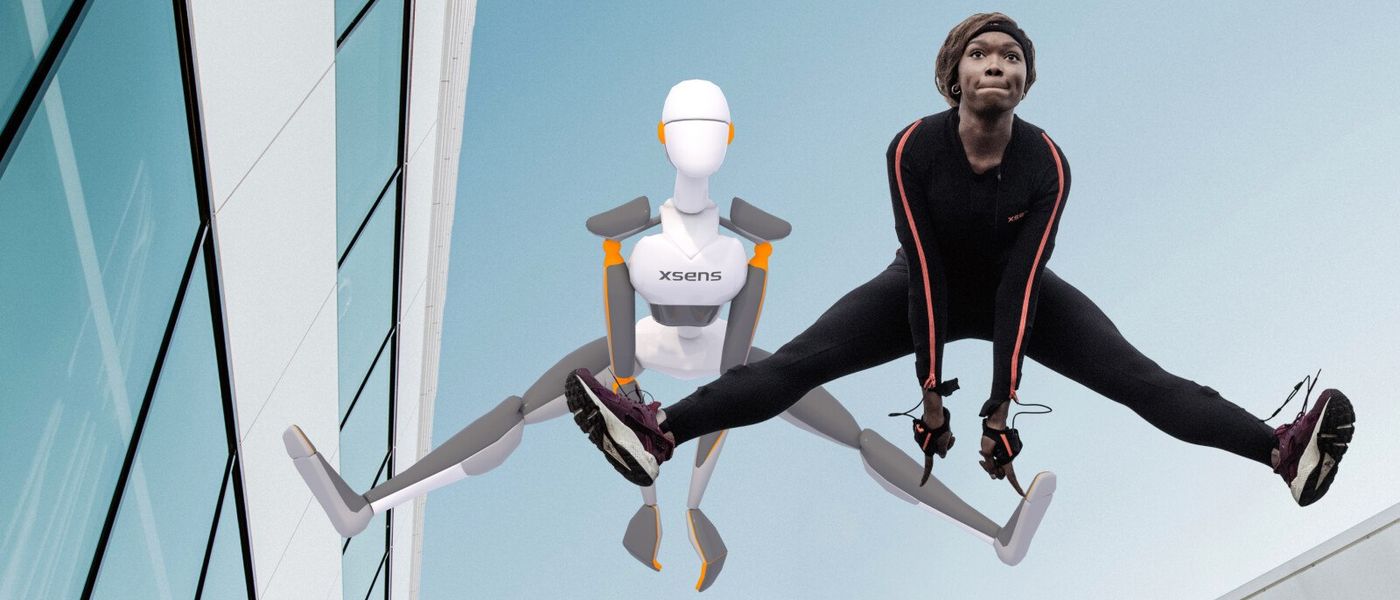
By fusing accelerometers, gyroscopes, and magnetometers, inertial suits reconstruct full-body posture in real time without needing a single camera line-of-sight [8]. The tradeoff, however, is “sensor drift” a term that refers to mathematical errors that accumulate over time, causing the digital skeleton to lose its grounding in physical space [8].
Robotics infrastructure needed a rugged, dependable way to mitigate this drift, and companies like Xsens (by Movella) emerged to meet this exact hardware need. By engineering robust filtering algorithms, Xsens provided a production-grade hardware standard for wearable IMU data [9], [10].
But as an AI company, buying a suit is only 5% of the battle.
Turning Hardware into AI-Ready Data Pipelines
Xsens and similar inertial systems are incredible tools, but they are pieces of hardware, not data pipelines. For an embodied AI team, the true challenge begins after the suit is turned on:
Humanoid Datasets: Transforming raw motion data into millions of hours of diverse, structured trajectories across varied terrains.
Whole-Body Teleoperation: Engineering low-latency streams that map human movements directly onto a robot chassis in real time.
Retargeting and Learning from Demonstration (LfD): Correcting for the fundamental architectural differences between a human skeleton and a robot topology without breaking the laws of physics.
AI labs shouldn’t be spending engineering hours on sensor calibration, coordinate frame alignment, or file format conversions. That is why we exist. We abstract the hardware complexities away, managing the entire operational lifecycle so your team receives pure, model-ready training data.
The Future is Multimodal
As we look toward the next generation of foundation models for robotics, the future of data collection won’t rely on motion capture alone. The most capable embodied AI systems will require multimodal synchronization.
The gold standard for a robot demonstration is a single, unified data stream that captures an action from every conceivable angle. Imagine a human collector wearing an inertial suit for full-body kinematics, paired with egocentric smart glasses for visual context, tactile gloves for force sensing, and spatial audio for environment cues, all perfectly time-synchronized with the robot’s internal state logs.
By treating motion capture as a core piece of a larger, multimodal data puzzle, we transform raw physical human capability into structured, robot-readable intelligence. As your dedicated data collection partner, we handle the logistics, the hardware aggregation, and the multimodal pipeline. You focus on building the models; we’ll give you the data to power them.
Nurvai’s Closing Thoughts
The trajectory of embodied AI is becoming increasingly clear. As models continue to improve, competitive advantage will be defined less by architecture alone and more by the quality, diversity, and synchronization of the data used to train them. The future is not a single modality, but a unified view of the physical world, where motion, vision, force, audio, and robot state are captured as one coherent demonstration.
At Nurvai, we’ve built our data collection infrastructure around this vision. We believe the next generation of robotics datasets will be inherently multimodal, combining complementary sensing modalities to capture not only what happened, but how and why it happened. Building these pipelines requires more than integrating hardware; it requires designing reliable, scalable workflows that transform raw sensor streams into AI-ready datasets.
With that future in mind, we’ve recently partnered with Xsens to incorporate industry-leading inertial motion capture into our data collection stack. By combining Xsens’ wearable motion capture technology with our expertise in multimodal data collection, synchronization, and dataset engineering, we’re expanding our ability to collect high-quality human demonstrations across a wider range of environments and robotic applications.
We see this as another step toward a broader goal: enabling AI labs to access the multimodal data they need to build more capable, adaptable, and general-purpose robotic systems. As the field continues to evolve, we’ll continue investing in the tools, partnerships, and infrastructure that make large-scale embodied AI data collection possible.
References
[1] R. Bandaru, “Foundation models for robotics: Vision-language-action (VLA).” Sep. 2025. Available: https://rohitbandaru.github.io/blog/Foundation-Models-for-Robotics-VLA/
[2] IBM Think, “The data gap that’s holding back robotics.” Mar. 2026. Available: https://www.ibm.com/think/news/the-data-gap-holding-back-robotics
[3] J. Ma et al., “HumanScale: Egocentric human video can outperform real-robot data for embodied pretraining.” 2026. doi: 10.48550/arXiv.2606.20521.
[4] Z. Xu, M. Hu, K. Xiao, Q. Fang, C. Liu, and Q. Chen, “Realizing text-driven motion generation on NAO robot: A reinforcement learning-optimized control pipeline.” 2025. doi: 10.48550/arXiv.2506.05117.
[5] MoCap Online, “Motion capture technology: Types & applications in 2025.” May 2026. Available: https://mocaponline.com/blogs/mocap-news/motion-capture-technology-guide
[6] Discover Computing, “An in-depth exploration of structural pose estimation strategies and datasets,” Discover Computing, 2025, doi: 10.1007/s10791-025-09726-8.
[7] A. Chromy, P. Sopak, and H. Cigler, “Validated low-cost standardized VICON configuration as a practical approach to estimating the minimal accuracy of a specific setup,” Scientific Reports, vol. 15, p. 23351, 2025, doi: 10.1038/s41598-025-06111-9.
[8] H. N. Hicks, H. Chen, and S. A. Harper, “Sensor fusion for enhancing motion capture: Integrating optical and inertial motion capture systems,” Sensors, vol. 25, no. 15, p. 4680, 2025, doi: 10.3390/s25154680.
[9] L. Rapetti, D. Ferigo, et al., “The bridge between xsens motion-capture and robot operating system (ROS).” 2023. doi: 10.48550/arXiv.2306.17738.
[10] Movella, “Products movella.” 2026. Available: https://shop.movella.com/us/health-sports/products